

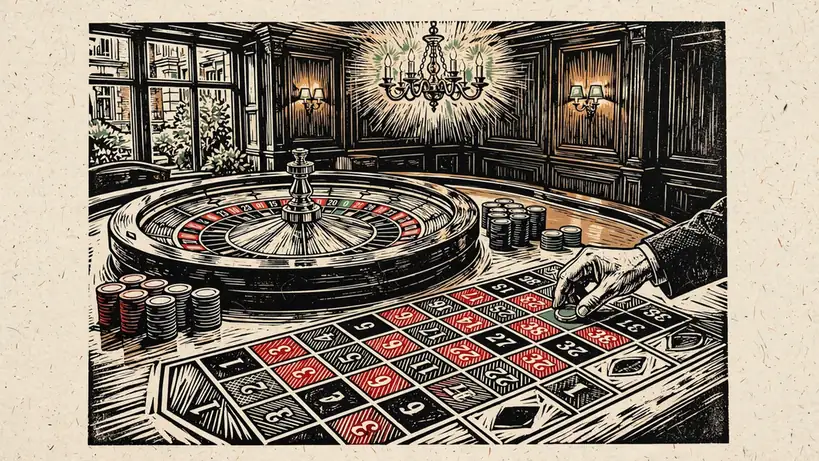
French roulette uses a single-zero wheel, but table rules determine whether qualifying bets receive French features.
What Makes French Roulette Different
French roulette is defined less by its name than by the rules attached to its single-zero wheel. Like European roulette, it has 37 pockets: the numbers from 1 to 36 and one zero. American roulette adds a double zero, making 38 pockets. That extra green pocket changes the probabilities and helps explain why the standard American game has a higher house edge.
The house edge is the casino’s mathematical advantage over time, expressed as a proportion of the amount wagered. It is not a prediction of what will happen in an individual spin, and it does not mean that a particular session will produce a particular loss. On standard European roulette, the house edge is 2.70%; on standard American roulette, it is 5.26%. The European wheel’s single zero gives it a lower edge than the American wheel, but French rules can reduce the advantage further on qualifying wagers.
Online American Roulette Casinos in the UK: What to Check
The distinction matters when you see French roulette offered at an online casino. A single-zero layout does not, on its own, tell you which rules apply. The table’s rules determine whether the French features are in effect, so check the game information rather than relying only on the title or the wheel shown on screen.
What La Partage changes
La Partage applies to even-money bets: wagers that pay the same amount as the stake when successful, such as a bet on red or black. If the ball lands on zero, half of a qualifying wager is returned instead of the whole stake being lost. The zero still matters, but it no longer produces a full loss on those bets.
That partial refund changes the long-run calculation. With La Partage, the house edge on even-money bets falls to 1.35%, compared with the standard European roulette edge of 2.70%. The rule does not improve every wager on the table; its stated reduction applies to even-money bets. It is therefore important not to treat the lower figure as the edge for every possible choice at a French roulette table.
This is the main reason French roulette can be more favourable, mathematically, than a single-zero game without the French rule. The wheel has the same number of pockets as European roulette, but the treatment of zero differs for qualifying wagers. If you are comparing games, look at both elements: the pocket layout and the rules that apply when zero appears.
Hi Lo Casino UK: What Live Search Results Confirm
En Prison and the standard variants
En Prison is another French rule associated with reducing the house edge. It affects qualifying wagers when the ball lands on zero, but its handling differs from La Partage: rather than immediately returning half the stake, the wager is held for another spin under the table’s rules. The rule can reduce the casino’s advantage, and French roulette is regarded as having the lowest house edge among standard variants because of La Partage and En Prison.
Do not assume that every table uses both rules, or that the same zero outcome is handled identically across games. Read the displayed rules to see whether La Partage, En Prison or both are available and which wagers qualify. The names describe specific conditions, not a blanket reduction on all bets.
The comparison is clearest when separated into wheel and rule effects. American roulette has a double zero as well as a single zero, and its standard house edge is 5.26%. European roulette has one zero and a 2.70% edge. French roulette uses the single-zero layout and may apply La Partage and En Prison, which lower the edge on the wagers covered by those rules. The 1.35% figure belongs specifically to even-money bets under La Partage; it should not be read as a universal French roulette rate.
What to check on an online table
When choosing an online French roulette game, confirm the wheel layout and open the rules panel before playing. A game labelled French roulette should make its zero rules clear. Check whether a zero triggers La Partage or En Prison, whether the feature applies to the wager you intend to make, and what happens to a wager held under En Prison. These details determine whether the lower-edge rules are relevant to your play.
French roulette’s advantage comes from a combination of a single-zero wheel and rules that soften the result of zero for certain wagers. It does not remove the casino edge or guarantee a better result in a short session.
The practical point is straightforward: French roulette’s advantage comes from a combination of a single-zero wheel and rules that soften the result of zero for certain wagers. It does not remove the casino edge, make outcomes predictable or guarantee a better result in a short session. It does, however, provide a clear mathematical distinction from standard European and American roulette—one worth checking in the table rules before you begin.
Roulette Bets and What They Pay
A French roulette layout offers bets that cover one number or several. The payout shown for a winning bet is the profit relative to the stake; the original stake is also returned. The main distinction is between inside bets, placed on numbers or groups of numbers in the central grid, and outside bets, placed on broader categories around it.
Inside bets
A straight-up bet selects a single number. If it wins, it pays 35:1: a £1 stake earns £35 in winnings, with the £1 stake returned as well. That payout is the same on European and American roulette, though the tables differ in their wheel layouts.
A split bet covers two neighbouring numbers, using a chip placed on the line between them. It pays 17:1 if either number wins. This gives you a wider selection than a straight-up bet, while the payout is lower because the bet covers more outcomes.
A street bet covers a horizontal row of three numbers and pays 11:1. These examples show how the payout falls as a bet covers more numbers. Check the layout and the table’s displayed rules before placing a chip, particularly if the game uses a modified format.
Fast Payout Online Casinos UK: What Claims Mean
Outside bets
Outside bets cover larger groups rather than particular numbers. Red or black, even or odd, and high or low each pay 1:1. A winning £1 stake therefore returns £1 in winnings plus the stake.
These bets are easier to follow on the layout, but they do not guarantee a win simply because they cover many numbers. Each spin is a separate result, and a sequence of previous outcomes does not make a particular colour or range more likely on the next spin.
When you open an online French roulette game, use the table’s help or rules panel to confirm which bets are available and how the displayed payout is expressed. The ratios above describe the standard payouts for the named bets; a game with additional features may set different terms for particular wagers. Pay attention to whether a figure refers to winnings alone or includes the returned stake, so you can compare the amount at risk with what a winning bet would pay.
Finding Casinos That Offer French Roulette
A casino may offer several roulette games without making the French version easy to spot. Its catalogue might group games under “roulette”, separate live tables from computer-generated games, or show a provider’s title rather than a rules-based description. A careful check means confirming both that the game is actually French roulette and that the operator is authorised to serve players in Great Britain.
Check the game details
- Confirm the game is actually French roulette
- Check the table rules for La Partage or En Prison
- Verify the operator holds a valid UK Gambling Commission licence
- Check the game’s information panel for its specific RTP
Search the catalogue, then check the table
Start with the casino’s own game catalogue. Search for “French roulette” and look through the roulette category if the search returns nothing. Some catalogues let you filter by game type or provider; others require you to browse a longer list. Check the game’s information panel or rules before treating a title as confirmation. A French-sounding name, a French-themed interface or a French flag in the artwork does not establish which rules the table uses.
The rules should identify the wheel and explain how a zero affects eligible wagers. Look for the terms La Partage and En Prison in the table information where those rules are offered. Their presence is more useful than a promotional label: it helps distinguish a French ruleset from a table that is simply styled to look French. If the rules are unavailable before launch, open the game and look for its information or help screen before placing a bet.
Catalogue descriptions can be brief, and the same game may appear under different headings. Try the casino’s general search as well as its roulette section, and check any available live-game or software-provider filters. A result labelled only “roulette” still needs inspection. If you cannot find rules that identify the format, ask the operator to confirm which version it is and where the table’s rules can be read. Do not infer the rules from a game thumbnail or from the casino’s general description of its roulette selection.
Fast Payout Online Casinos in the UK: Explained
A search for French roulette online casinos may bring up pages that list games or operators, but a listing is not proof that a particular table is currently available to you. Game catalogues can change, and access may depend on the operator’s own offering. Confirm the title from the casino’s catalogue and its in-game rules, rather than relying solely on a third-party description. If the game is available only through a particular app or account view, check that you can reach the same rules and table information there before playing.
Confirm the operator’s status
Game availability is only one part of the check. In Great Britain, online casino activity is overseen by the UK Gambling Commission, the country’s sole gambling regulator. An operator selling remote gambling to British customers must hold the relevant Gambling Commission licence, even if the business is based elsewhere. A website’s own claim that it is “regulated” is not enough to establish that it has permission to offer real-money casino games in this market.
Find the operator’s legal name and licence details on its website, often in the footer or in its terms. Then search the UK Gambling Commission’s public register and confirm that the licence belongs to the same company operating the casino. Check that the licence is current and covers the relevant remote casino activity. A familiar brand name alone may not identify the legal entity behind the site, so compare the registered company details rather than stopping at a logo or a licence badge.
Attention If the register details do not match the operator’s information, or you cannot identify the company responsible for the site, pause before creating an account or depositing.
If the register details do not match the operator’s information, or you cannot identify the company responsible for the site, pause before creating an account or depositing. A platform without a valid UKGC licence cannot legally offer real-money live roulette to British residents. An offshore address does not remove the requirement: operators serving the British market need the appropriate UK licence. The register provides a way to check the operator’s authorisation independently of its own marketing.
Treat availability as something to verify
The phrase “UK casinos with French roulette” can describe a broad range of catalogues, but it does not tell you whether a specific operator offers the rules you want today. Nor does the presence of one French roulette title mean every roulette table on that site follows the same rules. Check the individual game, since rules can differ between titles within a single catalogue.
Keep a record of the game name and the rules page you checked if the catalogue is unclear. If a table’s details conflict with the operator’s description, ask customer support to clarify before wagering. A clear answer should identify the specific game and point you to its rules, not merely repeat that the casino has roulette. This is a practical way to separate a confirmed French table from a generic roulette listing.
The same checks apply whether you are looking for a live table or an automated game. A label such as “premium” says nothing by itself about the rules or the operator’s legal status. First confirm the game’s actual rules; separately confirm the operator on the UK Gambling Commission register. That keeps the two questions distinct: whether a French roulette game is available, and whether the casino is authorised to offer it to players in Great Britain.
Best Keno Online Casinos in the UK: A Guide
How to Assess a French Roulette Casino
A French roulette table is only part of the decision. To judge whether a casino is clear and usable, look at the information attached to the exact game, how easily you can find it, and whether the terms explain what happens when something goes wrong. A polished lobby is less useful than rules and returns you can check before staking money.
Find the RTP for the exact game
RTP, or return to player, is a theoretical measure of the proportion of stakes a game is designed to return over extended play. It is not a promise about what you will receive in a session, and it cannot predict the result of your next spin.
A casino should make roulette RTP information accessible rather than leaving you to infer it from a general description of French roulette. Check the game’s information panel, rules screen or help section. If the figure is not visible there, look for a clearly signposted game-information page or ask customer support where it is published. An answer that points you to the relevant document is more useful than a vague assurance that the game is fair.
Make sure the information applies to the specific French roulette title or table you intend to open. A casino may offer several roulette games, and a figure for one title does not automatically describe another. The rules and return information should be consistent: if the game is presented as French roulette, check that its published details identify the rules that apply to that version. If you cannot establish which return figure belongs to which game, treat that as an unresolved point, not a detail to guess.
Understanding RTP
RTP, or return to player, is a theoretical measure of the proportion of stakes a game is designed to return over extended play. It is not a promise about what you will receive in a session, and it cannot predict the result of your next spin.
Read the game rules and casino terms together
The game’s own rules explain how a round is settled. The casino’s terms explain the operator’s conditions for using the game. Read both, because one does not necessarily answer every question raised by the other.
Look for a clear explanation of how bets are accepted, when a round is considered complete, and how the casino handles a technical interruption or an error. The terms should make it possible to understand what happens to a wager if a connection drops or a game result is disputed. If the wording is broad, contradictory or difficult to locate, contact support before playing and keep the reply. A written answer gives you something specific to refer back to.
Also check that the general casino terms do not quietly override the game information. Pay attention to definitions, exclusions and any clause that gives the operator discretion to cancel or amend a result. You do not need to assume that every clause will be used against you; you do need to know what it says before relying on the game’s on-screen explanation.
Live Casino Lightning Roulette UK: What to Check
Check who is accountable
For Great Britain, the UK Gambling Commission is the regulator of online casino activity and the sole regulator. When assessing an operator, check that the company named in the casino’s terms is the company responsible for providing the service. A brand name on a home page may not be the legal entity that runs your account, so the terms and regulatory information should make that relationship understandable.
This is a transparency check, not a substitute for reading the game details. An operator’s regulatory status does not tell you which French roulette rules a particular table uses or where its RTP is published. Conversely, a well-presented game page does not establish who is accountable for the casino. You need both pieces of information to make a grounded assessment.
Use a simple comparison
When weighing up options, compare the same things for each casino rather than relying on labels such as “best” or “premium”. Ask yourself:
- Can you find the RTP for the exact roulette game without searching through unrelated pages?
- Are the game rules readable and consistent with the information shown at the table?
- Do the casino terms explain how interrupted rounds, disputed outcomes and errors are handled?
- Is the responsible operator clearly identified in the terms and regulatory information?
- Does customer support give a direct, relevant answer when you ask about missing game details?
A casino that makes these points easy to verify gives you a clearer basis for deciding whether to play. If essential information is missing, or support cannot explain where it is, you can move on without treating an attractive presentation as evidence.
Low Stakes, Standard Tables and Premium Play
The stake range attached to a French roulette table matters as much as its name if you are trying to keep play within a set budget. A low minimum can make a table accessible, but it does not tell you how much you can stake in total, whether the limit suits your plans, or whether the same table will remain available later. Check the limits shown for the specific game before placing a bet; they can differ between tables and formats.
A specialist review has reported that some UK live roulette tables have minimum stakes beginning at 10p, while certain auto-roulette and speed roulette options have been listed from 5p. Treat these as examples of access points, not as guaranteed prices across the market. A casino may change its game catalogue or table limits, and the lowest advertised option may not be a French table. Confirm the game’s rules and limits on the table itself rather than assuming that every roulette listing offers the same range.
Low Limit
A small minimum stake that can be useful for controlling individual wagers or trying a table without a large commitment.
Standard Limit
A table that sits between the smallest-stake options and tables intended for larger wagers.
Premium/High-Limit
Tables positioned for customers who want to stake more, though the label does not define a specific maximum.
What “low limit” means in practice
A low-limit table has a small minimum stake, so you can place a bet without committing as much on each turn as you would at a higher-minimum table. That can be useful if you want to control the size of individual wagers or try a table without choosing a larger stake. It is not a measure of how favourable the game is: the minimum describes the entry point for a bet, not the likelihood of winning or the value of a payout.
Look at the minimum and maximum together. A table with an accessible minimum may still have a maximum that is unsuitable for your intended level of play, while a table with a wider range may give you more room to choose. The displayed limits apply to that particular table, so do not assume they carry over to another French roulette game from the same operator. If the game lists separate limits for different bets, read those as well.
The format can also affect the entry point. The reported 5p starting stakes concern some auto-roulette and speed roulette offerings; they are not a promise that every table in either category is available at that level. Likewise, the reported 10p starting point for some live tables does not mean that all live French roulette games use it. Compare the available tables on the basis of their actual limits, not a general label such as “low stakes”.
Standard tables and the middle ground
“Standard limit” is not a uniform industry setting. It is a useful description for a table that sits between the smallest-stake options and tables intended for larger wagers, but operators do not have to use the term consistently. One casino’s standard table may have a different minimum from another’s, and a table described as standard may still have a maximum that you would not want to approach.
For that reason, treat labels as navigation, not as evidence of a particular stake range. Check the amount shown for each table and decide whether both ends of that range make sense for you. If the interface does not make the limits clear before you join, choose a table where they are visible rather than relying on a category name or a promotional description.
French roulette is not inherently a low-stakes game; the minimum and maximum limits are features of the particular table offered, not the game format itself.
French roulette is not inherently a low-stakes game. Its format does not by itself determine a table’s minimum or maximum; those are features of the particular table offered. The fact that a low-entry option exists somewhere in a casino’s roulette catalogue does not establish that its French roulette tables have the same entry point.
Premium and high-limit tables
Premium play generally refers to tables positioned for customers who want to stake more, but the label alone does not establish a maximum stake, a special French roulette wheel or any added service. A “VIP” or high-limit heading can describe how an operator groups games rather than set out a standard market-wide definition. Read the table information instead of inferring benefits from the name.
There is no fixed VIP maximum that can be assumed across UK casinos from these labels. Maximum stakes depend on the individual table, and an operator may offer different limits across its games. Nor does a premium label establish that a table includes personal assistance, exclusive access or other benefits. If those features matter to you, look for their terms in the operator’s own information and distinguish them from the game’s betting limits.
A higher ceiling is not automatically an advantage. It simply allows larger wagers, and it can make it easier to exceed the amount you meant to spend. Consider whether the full range suits your intended budget, not just whether the table permits the stake you had in mind. If the listed maximum is much higher than you need, that is not a reason to use it; the minimum and the limits you set for yourself are more relevant to choosing a suitable table.
Live Baccarat Online Casinos in the UK
Compare the table, not the label
A practical comparison can be brief: confirm that the table is French roulette, note its minimum and maximum, and check whether those limits apply to the bets you intend to make. Compare tables individually, especially when the casino groups live, automated and premium options under separate headings. A low minimum on one format does not establish the minimum on another.
If you are choosing between a low-stakes option and a premium table, the meaningful difference is the permitted stake range, not the prestige suggested by a label. Pick limits that fit your own plans and leave the table if its range encourages you to stake more than you intended. The available minimums vary; a casino’s terminology cannot make them consistent.
Live Dealers, Auto Roulette and Faster Spins
A live French roulette table gives you a view of a physical wheel rather than a computer-generated result. A studio stream shows a human dealer releasing the ball and the wheel turning, so each spin has a visible sequence of events. The stream can make the game feel closer to a land-based table, but it also means you wait for the dealer and the ball to complete each round.
RNG roulette works differently. RNG stands for random number generator: software produces the simulated spin result instead of a ball landing in a pocket on camera. This format can move more quickly, and its minimum stakes can be lower. The result is not a live wheel spin, even if the screen uses roulette graphics or displays a wheel animation.
Live Dealer
A physical wheel is shown via a studio stream, providing a visible sequence of events.
RNG Roulette
Software produces the simulated spin result using a random number generator.
Speed Roulette
A format designed to shorten the wait between rounds, capable of more than 150 spins per hour.
“Auto roulette” can refer to an automated format, but the label alone does not tell you precisely how the result is generated. Check the game description: it should make clear whether you are watching a physical wheel, playing an RNG simulation, or using another format. A live casino French roulette game is not the same thing as an automated game merely because both appear in a casino’s roulette catalogue.
Spin rates help explain the practical difference, although they should be read as format-specific figures rather than a promise about every table. A specialist review gives speed roulette as capable of more than 150 spins per hour, compared with 80–100 spins per hour at a standard table. That is a substantial change in pace: less time passes between decisions, and the balance can move through rounds more quickly.
A separate comparison for American roulette puts RNG play at 150 to 200 or more spins per hour, against 50 to 60 spins per hour for live dealer play. Those figures concern American roulette and should not be treated as a precise forecast for a French roulette table. The provider, interface and table format can all affect the pace. The useful point is that a simulated game may run faster than a streamed dealer game, while a speed format is designed to shorten the wait between rounds.
If you prefer to follow the physical ball drop, live play offers that process on screen. If you want fewer pauses, an RNG or speed format may suit you better. Neither format changes the basic uncertainty of a roulette result; faster play simply means that decisions and results arrive closer together. Take a moment to identify the format before starting, particularly where a game title does not make clear whether the wheel is physical or simulated.
Live Blackjack Online Casinos in the UK: Rules & Play
Before You Play: Limits, Verification and UK Safeguards
Before opening an account to play French roulette, check that the operator has a valid licence from the UK Gambling Commission (UKGC). It is the regulator responsible for online casino gambling in Great Britain. A platform without a current UKGC licence cannot legally offer real-money live roulette to British residents. You can confirm an operator’s status by checking its licence number against the Commission’s public register before depositing.
UK rules require operators to verify your age before allowing you to deposit. Online gambling is for people aged 18 and over, but do not treat an age prompt at registration as proof that the checks are complete: the operator must verify your age before funds can be deposited.
A UKGC-licensed operator must prompt new customers to set a financial limit before their first deposit and make account-level limit controls accessible. These tools let you set boundaries around gambling activity; review them in your account rather than assuming they will be applied without your input.
UKGC-licensed live casino operators must also provide deposit limits, loss limits, session time reminders, reality checks, cool-off periods and GamStop self-exclusion. GamStop lets you exclude yourself from gambling with participating licensed operators. The controls serve different purposes: limits restrict what you can spend, reminders and reality checks help you keep track of time, and a cool-off period or self-exclusion can prevent access for a chosen period or longer.
Essential Safeguards
- Check the UK Gambling Commission public register to confirm the operator’s licence.
- Set financial limits and session time reminders within your account.
- Use tools like GamStop for self-exclusion if required.
- Access the internal complaints process and Alternative Dispute Resolution if needed.
Check that these options are available and understand how to activate them before you play. If you have a complaint about an operator, UKGC licensees must provide an internal complaints process and access to an approved Alternative Dispute Resolution service. These safeguards do not remove the financial risks of gambling, but knowing where the controls are gives you a practical way to act if you need them.
Bonuses and French Roulette Wagering Terms
A French roulette table may be included in a casino offer, but that does not mean every stake will help you clear its bonus wagering requirement at the same rate. Operators set game weighting, and roulette can be treated differently depending on whether you play a live table or an RNG game, where a random number generator simulates the spins.
Most UK operators count roulette wagers at 10% to 20% of the wagering requirement. A specialist review reports that live roulette may be weighted at 10% or 20%, while RNG roulette may count at 100%. These figures are not a universal rule: the offer terms for your account and the specific game are what matter. A table’s French rules do not, by themselves, establish how its wagers count.
Before accepting bonus funds, look for the games eligible for wagering and the game-weighting table. Check whether the terms distinguish live roulette from RNG roulette, and whether a particular French roulette title is excluded. If the wording is unclear, ask the operator to confirm how that exact game is treated before you play. Otherwise, you may find that a substantial amount of play makes little progress towards clearing the requirement.
There is also a UK-wide cap to take into account. Since January 2026, licensed operators have been subject to a maximum bonus wagering requirement of 10x. That cap does not make all offers equally useful: game weighting and the other conditions still affect how much qualifying play is needed. Read the applicable terms rather than assuming that a casino French roulette game contributes at the same rate as another roulette format.
A Practical Way to Play Online
The Martingale is a betting system built around doubling your stake after every loss. Its appeal is easy to understand: a later win may seem as though it could recover earlier losses and leave a small profit. But that apparent simplicity hides how quickly the required stake grows during a losing run.
Each loss makes the next bet larger, while the money already lost remains gone unless a later result wins. A losing streak can therefore put serious pressure on your bankroll. It may also reach a point where you cannot afford the next doubled stake or the table does not accept it. The system does not remove risk; it concentrates more of your money into successive bets.
This matters when you play French roulette online casino games just as it does at other roulette tables. La Partage and En Prison can affect certain outcomes, but neither changes the result of the next spin into something predictable. A previous loss does not make a win due, and a run of wins does not make a loss overdue.
Roulette results are determined by chance. No staking pattern can identify where the ball will land or guarantee that a sequence of bets will recover losses. The Martingale changes the size of your wagers, not the underlying uncertainty.
If you choose to use it, decide in advance how much you are prepared to lose and stop when that amount is reached. Do not treat a winning result as proof that the system works: a short run cannot establish what will happen next. A betting method can organise decisions, but it cannot make roulette predictable.