

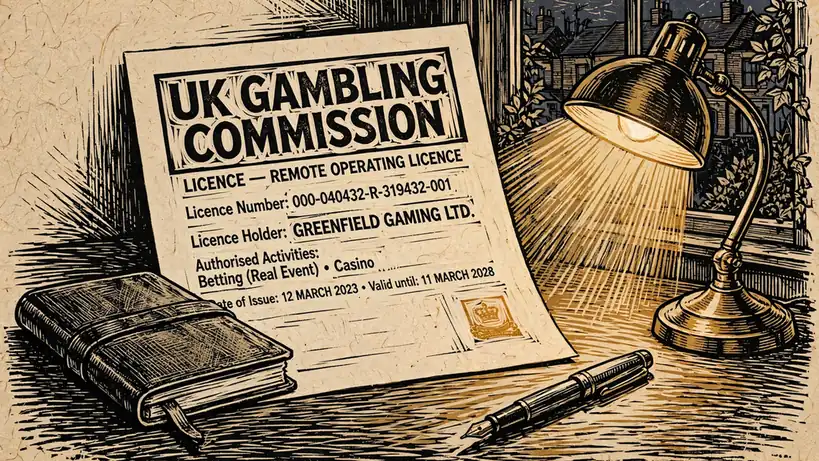
The guide compares UKGC authorisation with overseas licensing and explains the legal, protection and complaint-route differences.
What UK Gambling Commission Licensing Means
For an online casino to serve customers in Great Britain, the operator must hold a licence from the UK Gambling Commission (UKGC). The rule applies whether the company is based in Britain or operates from another country. A business cannot avoid the requirement simply by placing its headquarters or website infrastructure elsewhere.
This is the starting point for understanding UK-regulated online casinos. The relevant question is not just where a company is incorporated, or which country appears in its branding. It is whether the operator serving customers in Great Britain has the required UKGC licence. A casino licensed by another jurisdiction is not, on that basis alone, licensed to serve the British market.
The distinction matters because “licensed” can mean different things in different contexts. A company may hold permission from a regulator outside the UK, but that does not make it UK-regulated. For a casino to be licensed and regulated for customers in Great Britain, the UKGC must have authorised the operator to provide the relevant gambling service here.
The operator’s location does not change the requirement
The licensing rule follows the market being served, not the operator’s address. An online casino based abroad that accepts customers in Great Britain still needs a UKGC licence. Equally, a company’s presence in Britain does not, by itself, establish that it holds the licence needed to provide online gambling.
This helps explain why terms such as “international,” “foreign” or “non-UK-based” do not answer the main regulatory question. They describe a location or presentation, not the operator’s permission to serve British customers. The same is true of a licence issued by another country: it may show that an overseas authority has licensed the business, but it does not replace UKGC authorisation for the British market.
In practical terms, a UK-regulated online casino is one whose operator is authorised by the UKGC to serve customers in Great Britain. The licence is not simply a badge that can be transferred from one jurisdiction to another. Nor does a foreign licence become a UK licence because a website is accessible from a British address.
Casino Sites: UK Licensing and Access Guide
What the licence establishes
A UKGC licence establishes that the operator has the regulatory permission required to offer gambling to customers in Great Britain. It is therefore central to the distinction between a casino operating within the British regulatory system and one operating outside it.
That distinction should be kept separate from questions about where a casino is headquartered, what currency it accepts, or how its website is designed. Those details do not determine whether the operator holds the necessary UK licence. A site can look familiar to British customers and still lack UKGC authorisation; conversely, the operator’s location abroad does not prevent it from being licensed to serve Great Britain.
If you are trying to work out which online casinos are licensed and regulated for this market, focus on the operator’s UKGC status rather than relying on a general claim that the casino is “licensed.” The wording alone can be incomplete: it may refer to a regulator elsewhere. The relevant point is whether the operator has the licence required for Great Britain.
Great Britain is the relevant market
The licensing requirement described here applies to operators serving customers in Great Britain. That geographic wording matters: Great Britain means England, Scotland and Wales. It should not be casually treated as interchangeable with the whole of the United Kingdom, since the UK’s gambling framework does not apply identically in every part of the country.
For customers in Great Britain, the baseline is straightforward: an online gambling operator must hold a UKGC licence to serve the market, wherever that operator is based. A casino licensed only outside the UK does not meet that requirement merely by having a valid licence in its own jurisdiction.
This is the useful dividing line when comparing UK-regulated online casinos with online casinos regulated outside the UK. It does not depend on a site’s name or appearance, and it is not altered by the operator’s overseas address. What matters is whether the company offering gambling to customers in Great Britain has the authorisation of the UK Gambling Commission.
UKGC Licensed
Operators are authorised by the UK Gambling Commission to serve customers in Great Britain.
Non-UK Regulated
Operators are supervised by a different authority, such as Malta, Curaçao, Gibraltar or Anjouan.
Unregulated
Sites operating without oversight from any recognised regulatory body.
How Non-UK Regulation Differs
A non-UK-regulated casino is an online gambling site that operates without oversight from the UK Gambling Commission (UKGC). The term describes the regulator that does not supervise the site; it does not necessarily mean the casino has no licence at all. Many such operators are licensed by another jurisdiction, so their regulatory status is tied to a different authority.
Malta, Curaçao, Gibraltar and Anjouan are among the jurisdictions commonly associated with these casinos. A site licensed in one of those places may describe itself as regulated, but that statement refers to its licensing jurisdiction. It does not establish UKGC oversight. The distinction is easy to miss when a casino uses broad terms such as “licensed” or “regulated” without making clear which authority it means.
The operator’s location and its regulator are also separate details. A company may be based in one country while holding a licence issued by another jurisdiction. For that reason, a site’s name, branding or apparent location alone does not tell you which regulator, if any, oversees its gambling activity. The relevant label is about the oversight attached to the service, not simply where its website or business appears to be based.
This also means that “non-UK-regulated” is not the same as “unregulated everywhere”. A casino may be subject to rules in the jurisdiction that licensed it while remaining outside the UKGC system. The phrase identifies an absence of UKGC supervision; on its own, it does not describe the scope or strength of the other regulator’s rules. Those details depend on the particular licence and authority.
Non-UK Registered Casinos: Regulation Explained
When a site refers to a foreign licence, note the name of the issuing jurisdiction rather than treating the word “licensed” as a complete description. Malta, Curaçao, Gibraltar and Anjouan are not interchangeable labels: they point to different licensing jurisdictions. Nor does naming one of them make a casino UK-regulated. The same distinction applies if a site calls itself international or uses another general description of its operations.
In ordinary use, then, a non-UK-regulated casino is a casino outside the UKGC’s oversight, whether or not another jurisdiction has issued it a licence. That definition is narrower than a judgement about how well the site is run. It tells you where UK regulation is absent, not what protections another regulator provides or how a particular operator handles its business. To understand the label, keep those questions separate: first identify whether UKGC oversight applies, then identify any other licensing jurisdiction the operator names.
What UK Law Says About Using Offshore Casinos
UK law draws an important distinction between the company offering gambling and the person placing a bet. The Gambling Act 2005 is aimed at operators supplying gambling services to the British market. A company serving customers in Great Britain needs a UK Gambling Commission (UKGC) licence, even if it is based abroad. Holding a licence from another country does not replace that requirement.
Do
- Check the operator’s UKGC status directly.
- Verify the issuing jurisdiction of any foreign licence.
- Read the specific terms for your payment and withdrawal methods.
Don’t
- Assume a foreign licence makes a site UK-regulated.
- Treat a site’s availability as proof of legal authorisation.
- Rely on a casino’s branding to determine its regulatory oversight.
The Act applies in England, Wales and Scotland; Northern Ireland has a separate legal framework. This matters when you are considering a service from outside the UK: the location of the operator, the licence it claims to hold and the rules where you live are not interchangeable. A site may be licensed in another jurisdiction yet still lack the authorisation required to serve customers in Great Britain.
That obligation rests on the operator. It does not mean that a British player who uses an unlicensed gambling site commits a criminal offence under UK law. Nor does UK law explicitly prohibit British citizens from using gambling services licensed in other countries. Those points concern the player’s position; they do not make the operator’s service authorised for the British market.
The distinction can be easy to miss when a site accepts registrations from people in Britain or displays a foreign licence. Acceptance is not proof of permission to operate here. The relevant question is whether the operator has the UKGC licence required for supplying gambling services to customers in Great Britain. A licence issued elsewhere may be valid under the issuing jurisdiction’s rules, but it does not confer UKGC status.
For that reason, the phrase “offshore casino for UK players” can describe a service that is reachable from Britain without establishing that it is legally authorised to supply the British market. The same applies to non-GAMSTOP casinos for UK players: a site’s availability, or its absence from a self-exclusion scheme, does not answer the licensing question. Those are separate issues.
Non-Gamban Casinos in the UK: What Access Means
If you are assessing a non-UK-regulated casino accepting UK players, do not treat its terms of service, marketing or foreign licence as a substitute for checking which regulator authorises it and what market that authorisation covers. You are responsible for checking the law that applies where you live and for understanding the implications of using a gambling service based elsewhere. Rules can differ by jurisdiction, and a licence in one country does not settle the legal position in another.
There is also a difference between saying that a player is not criminally liable and saying that a particular service is lawful for the operator to provide in Great Britain. The first does not cancel the second. If an operator supplies gambling to customers here without the required UKGC licence, the licensing requirement still applies to that operator, regardless of whether individual customers face criminal prosecution for playing.
This is the central legal point when comparing UKGC-licensed services with non-UK-regulated casinos: the operator’s duties depend on the market it serves, while the player’s legal position is a separate question. Do not infer that a foreign licence makes a casino UK-regulated, or that a site’s willingness to accept a British customer confirms that it is authorised to do so. Before using an offshore service, check the rules that apply to you and consider what it means to deal with an operator outside the UK regulatory system.
GAMSTOP and the Safeguards You May Lose
GAMSTOP is the UK’s self-exclusion scheme for online gambling. If you register, participating operators are expected to prevent you from using their gambling services for the period you select. A casino that is not part of the scheme does not receive that instruction through GAMSTOP. Your registration therefore does not block you from opening or using an account there.
Attention
Registration with GAMSTOP does not automatically block you from using casinos that are not part of the scheme.
That distinction matters if you have self-excluded because gambling has become difficult to control. A block that works across participating UK-licensed sites is not a universal barrier to gambling online. You may still be able to reach a site outside the scheme, and its own account controls are separate from your GAMSTOP registration. Do not treat access as proof that a site is safe to use, or assume that your UK self-exclusion will protect you there.
The same practical gap applies to tools intended to help you manage gambling. UK-licensed operators must provide mandatory responsible-gambling tools; casinos operating outside that system do not have the same UK requirements. Features such as deposit limits or self-exclusion may be offered by an individual site, but you should not assume they are available, work in the same way, or connect to GAMSTOP. A site’s own limit is not a substitute for a scheme-wide exclusion.
This can leave you relying on controls that apply only within that operator’s account. If you close an account or set a limit there, that does not automatically prevent you from registering elsewhere. Before using any site, find out what account controls it offers and how they can be activated. If you have already self-excluded because you need gambling to stop, seeking out casinos outside GAMSTOP can undermine the purpose of that decision.
Trusted UK Casinos: Licence and Safety Checks
There is also a difference in where you can turn when a dispute arises. Players using offshore casinos lose access to the UK’s Financial Ombudsman Service and to the mandatory responsible-gambling protections that apply under the UK system. That does not mean every complaint will be ignored, but it does mean you should not expect the UK route or its safeguards to apply to the operator. The site’s own customer-service process is not the same thing as an independent UK complaint service.
A casino regulated outside the UK may present itself as licensed in another jurisdiction. That does not make it part of GAMSTOP, and a foreign regulator’s involvement does not restore UK self-exclusion or complaint protections. The label “regulated” on its own tells you neither whether the operator participates in GAMSTOP nor what practical help you can access if something goes wrong.
Keep the two questions separate: whether you are legally permitted to use a service is one issue; what protections and support remain available if you do is another. If you rely on GAMSTOP, assume it will not block a casino outside the scheme. Check the operator’s own controls before considering an account, and do not mistake their presence for the broader protections attached to UK-regulated gambling.
Anjouan Licences: What They Do—and Don’t—Authorise
An Anjouan casino licence is not permission to serve customers in every country. In particular, it does not authorise an operator to run a gambling service in the United Kingdom. A casino may display an Anjouan licence and still lack the UK Gambling Commission licence required to serve customers in Great Britain.
An Anjouan licence provides authorisation under Anjouan’s framework but does not grant permission to operate in the United Kingdom.
That distinction matters because a licence issued in one jurisdiction does not replace the authorisation required in another. The Anjouan licence should therefore be understood within its own limits, not as a general approval for a casino to accept players wherever it chooses. It does not override restrictions applying in the UK or in other markets where Anjouan-licensed operators are not authorised to operate.
A licence badge can make a site look officially recognised, but it does not tell you that the operator is approved by the UK regulator. Nor does it mean that the protections associated with UK-regulated gambling apply. If you are assessing a casino not regulated by UKGC, the relevant question is not simply whether it displays a licence. You also need to understand which authority issued it and what that licence does—and does not—cover.
The same limits apply to familiar UK safeguards. Anjouan-licensed casinos are not required to connect to GAMSTOP, the UK’s online self-exclusion scheme. An Anjouan licence therefore gives no assurance that a person who has registered with GAMSTOP will be blocked from opening or using an account at such a casino.
Dispute handling is another point on which the systems differ. UK-licensed operators must use an approved independent dispute resolution process. An Anjouan-licensed casino is not required to provide a comparable independent service. That means the presence of an Anjouan licence should not be read as a promise that an independent body with a UK-equivalent role can review a disagreement between you and the operator.
Online casino no registration in the UK: what it means
“Independent dispute resolution” means a process in which an outside organisation considers a complaint rather than leaving the matter solely to the operator. The distinction is practical: a casino’s licence may identify the framework under which it operates, but it does not by itself establish a UK-style route for independent review.
These limits do not make the licence meaningless; they define what it can establish. It may indicate that the operator holds authorisation under Anjouan’s framework, but it does not confer UK permission, require GAMSTOP integration, or ensure access to a UK-comparable independent dispute route. Treating those as separate questions avoids mistaking a foreign licence for broader protection than it provides.
Payments, Bonuses and the Cost of Waiting
A payment option shown at deposit does not necessarily tell you how you can withdraw. Non-UK-regulated casinos may accept credit cards, e-wallets, bank transfers and cryptocurrencies, sometimes using payment processors other than those familiar from UK-regulated casinos. Before sending money, check the cashier’s withdrawal rules as well as its deposit options. A method may be available for funding an account but unavailable for paying out, or the operator may require you to use a different route.
Crypto is another option at some sites. Paying with cryptocurrency can bypass the UK ban on credit-card-funded gambling, but that describes the payment mechanism, not the operator’s regulatory status or the protections attached to your account. A casino does not become regulated in the UK because it accepts crypto. The currency used to move funds and the authority responsible for the operator are separate matters.
Withdrawal and Payment Rules
Non-UK-regulated casinos may have different rules for depositing and withdrawing funds. A method available for deposits might not be available for withdrawals, and there is no regulatory clock to enforce payout deadlines.
Withdrawal times are not described consistently. Some accounts say payments can arrive within 24 hours to five business days; others warn that a withdrawal may take three or four weeks. The difference matters: there is no regulatory clock to enforce a payout deadline at a non-UK-regulated casino. A stated processing time is not the same as a guaranteed date that an outside regulator can make the operator meet.
Read the terms for the particular payment method, including any identity checks and conditions that could delay a withdrawal. Keep copies of the relevant terms and records of deposits and payout requests. If an account is held for review, or a payment is delayed, you may have little leverage beyond the operator’s own process. A deposit confirmation does not settle whether a later withdrawal will be approved or when it will reach you.
Bonuses need the same close reading. A welcome offer can tie a withdrawal to wagering requirements: the amount of qualifying play required before bonus-related funds can be withdrawn. A specialist review has reported offshore welcome bonuses with requirements of 35x or more, but that is not a standard that applies to every offer. The applicable terms can differ between casinos and promotions, so check what the multiplier applies to, which games count and whether the bonus has other restrictions before accepting it.
The headline bonus is only one part of the decision. If the conditions are unclear, or you would not deposit without the offer, declining it may avoid turning a simple withdrawal into a dispute about whether its requirements have been met. Treat both payment speed and bonus value as claims to verify in the operator’s terms, not as promises secured by the payment method.
VPN-Friendly Casinos in the UK: Rules and Risks
Casinos Outside the UK and GAMSTOP: What the Labels Tell You
“Licensed outside the UK” and “not on GAMSTOP” describe two different things. The first refers to where a casino’s licence comes from. The second says whether it is part of the UK Gambling Commission’s self-exclusion scheme. A casino may fit both descriptions, but one does not automatically prove the other.
Casinos not on GAMSTOP are not included in that scheme. So the label tells you about their relationship to self-exclusion, not which regulator oversees them. Likewise, knowing that a casino holds a licence from another jurisdiction does not, by itself, tell you whether it is on GAMSTOP.
Non-UK-regulated casinos are commonly associated with licensing jurisdictions such as Malta, Curaçao, Gibraltar and Anjouan. These names can help you understand where an operator says its regulatory oversight comes from. They are not a list of casinos, nor do they establish that every operator licensed in one of those places has the same terms or protections.
The distinction matters when you encounter descriptions such as “Curaçao casinos outside GAMSTOP”. That wording combines a licensing location with a statement about scheme membership. Treat each part as a separate claim: a Curaçao licence concerns the stated regulator, while being outside GAMSTOP concerns participation in the UK scheme. Neither label substitutes for the other.
A casino’s branding or the wording on a review page may not make the distinction clear. Look for what the operator says about its licence and whether it identifies itself as part of GAMSTOP, rather than assuming that one status follows from the other. If a page uses “non-UK-regulated” and “not on GAMSTOP” as though they were interchangeable, it is simplifying two separate descriptions.
Key Conclusions
- Licensing jurisdiction and GAMSTOP status are two separate matters.
- A foreign licence does not substitute for UKGC authorisation in Great Britain.
- Protections like independent dispute resolution and mandatory responsible gambling tools vary by regulator.
These labels are useful as a starting point, not a complete account of a casino. A licence jurisdiction tells you where an operator claims to be regulated; GAMSTOP status tells you whether it belongs to the UK self-exclusion scheme. Keeping those questions separate makes it easier to understand what each description actually says—and what it leaves unanswered.
Who Regulates Online Slot Machines?
For online slots, regulation is principally about the operator providing the game to you. In Great Britain, a company serving customers with online casino games must hold a licence from the UK Gambling Commission (UKGC), whether it is based in Britain or elsewhere. Slots fall within that wider category of online casino games.
That means the location of a website’s operator does not, by itself, determine which regulator is relevant. If the operator serves customers in Great Britain, the UKGC licensing requirement applies. A company cannot avoid that requirement simply by running its business from another country.
The distinction matters when you see a casino describing itself as licensed overseas. A licence from another jurisdiction is not the same as a UKGC licence, and it does not satisfy the requirement for an operator serving Great Britain. The question is not only whether a site displays a licence badge, but whether its operator holds the licence required for this market.
So, are online slot machines regulated? The practical answer is that the UKGC regulates the operators offering them to customers in Great Britain. The requirement applies to the service that makes the games available, rather than being limited to one particular slot or game title. A casino offering slots as part of its online gambling service is still subject to the relevant operator-licensing rule.
When considering a site, look for the identity of the company operating it and whether it holds a UKGC licence. A game’s appearance on a website, or the presence of a separate foreign licence, does not establish that the operator has permission to serve customers in Great Britain. Nor does describing a site as international change where the UK requirement applies.
This is the basic answer to how online slot gambling is regulated in Great Britain: the operator must be licensed by the UK Gambling Commission when it serves customers here, regardless of where it is based. The regulator to focus on is therefore the one responsible for the operator’s permission to serve this market—not simply the country named in the casino’s promotional material.
How to Check an Anjouan Casino Licence—and Its Complaint Route
An Anjouan casino licence should be checked against the regulator’s public register, not accepted on the strength of a badge displayed on a casino’s own website. Look for an entry for the operator and confirm that the licence has not expired. The company named in the register should match the legal company identified in the casino’s terms and conditions. If the names differ, or you cannot find an entry, the licence does not establish that the site is covered by the framework you are relying on.
Licence Verification
- Locate the operator’s name in the issuing jurisdiction’s public register.
- Confirm the licence is currently valid and has not expired.
- Ensure the company name in the register matches the casino’s legal terms.
This is a different check from verifying a UKGC casino licence. An Anjouan listing is not a UK Gambling Commission licence, and it does not show that the operator is authorised to serve customers in Great Britain. If a casino claims to hold a UKGC licence, check that claim against the Commission’s own public register rather than treating another jurisdiction’s register as equivalent.
A licence entry also has limits as evidence. Anjouan’s framework does not require casinos to have their random number generator (RNG) tested or to undergo audits. Nor does it require player funds to be kept separate from the operator’s money. A register entry therefore confirms a licensing record; it does not, by itself, verify that games have been independently tested or that funds are protected if the business fails.
What happens if you complain?
The Anjouan authority does not take up player complaints, mediate between a casino and its customer, or issue decisions on individual disputes. The framework instead requires the operator to respond to a complaint within 30 calendar days. A response is not the same as an independent ruling, and the deadline does not mean that the authority will intervene if you remain dissatisfied.
Before depositing, read the operator’s complaint procedure and keep copies of relevant messages, account records and the terms that applied to your play. These records may help you explain a dispute to the operator, but they do not create an external appeal route. An Anjouan casino licence does not require an independent dispute-resolution process comparable to services approved for UKGC-licensed operators.
Treat the licence check as a way to establish what the register says, not as a guarantee of game fairness, financial protection or a remedy if a complaint is unresolved. If the company name, status or expiry information is unclear, do not assume that a licence badge answers those questions.
What You Give Up When a Casino Is Not UKGC-Regulated
A casino regulated by the UK Gambling Commission operates under consumer protections that do not automatically extend to a site outside its oversight. At a non-UK-regulated casino, responsible-gambling requirements and data-protection standards may be weaker. That does not mean every such operator handles customer information or gambling risks poorly; it means you cannot assume the same UK rules apply.
The practical difference can become important when something goes wrong. If an operator changes its terms, restricts your account or disputes a payment, you cannot take the matter to UK regulators as though the casino were under their authority. Nor can you use the UK’s Financial Ombudsman Service for a dispute with an offshore gambling operator. The absence of those routes does not prove that a complaint will be ignored, but it leaves you without those UK avenues of redress.
You also give up access to responsible-gambling measures that UK-licensed operators are required to provide. Without those obligations, the protections available may depend more heavily on the individual operator’s own policies. If you are trying to control your gambling, that difference is not merely administrative: a site’s voluntary tools are not a substitute for safeguards required under UK regulation.
Data handling deserves the same scrutiny. Before sharing identity or payment information, consider what rules govern the operator and what options you would have if your information were mishandled. A familiar-looking website or a licence from another jurisdiction does not, by itself, establish that UK standards apply.
These are not guarantees that every interaction with a non-UK-regulated casino will end badly. They are limits on the protection available if it does. Before using one, weigh the operator’s own terms and safeguards against the fact that UK regulators cannot resolve a dispute or enforce a later change to those terms on your behalf.
Are Anjouan-licensed casinos safe and fair?
An Anjouan licence alone does not guarantee that a casino is safe or fair. Anjouan’s framework does not require RNG testing, audits or segregation of player funds, and the regulator does not adjudicate player complaints.
Can I complain to the Anjouan regulator if a casino won’t pay me?
No. The Anjouan authority does not handle or mediate player complaints, and Anjouan-licensed casinos do not have an independent dispute-resolution route comparable to UKGC-approved ADR.
Are sites that are not on GamStop legal for players in the UK to access?
UK law does not explicitly prohibit you from using gambling services licensed in other countries, and players do not commit a criminal offence by gambling on unlicensed sites. However, operators serving customers in Great Britain need a UKGC licence, and sites outside the UK system are not part of GamStop.
Are gaming sites not on GamStop permitted for UK players?
UK law does not explicitly prohibit you from using gambling services licensed in other countries, and players do not commit a criminal offence by gambling on unlicensed sites. However, operators serving customers in Great Britain need a UKGC licence, and sites outside the UK system are not part of GamStop.